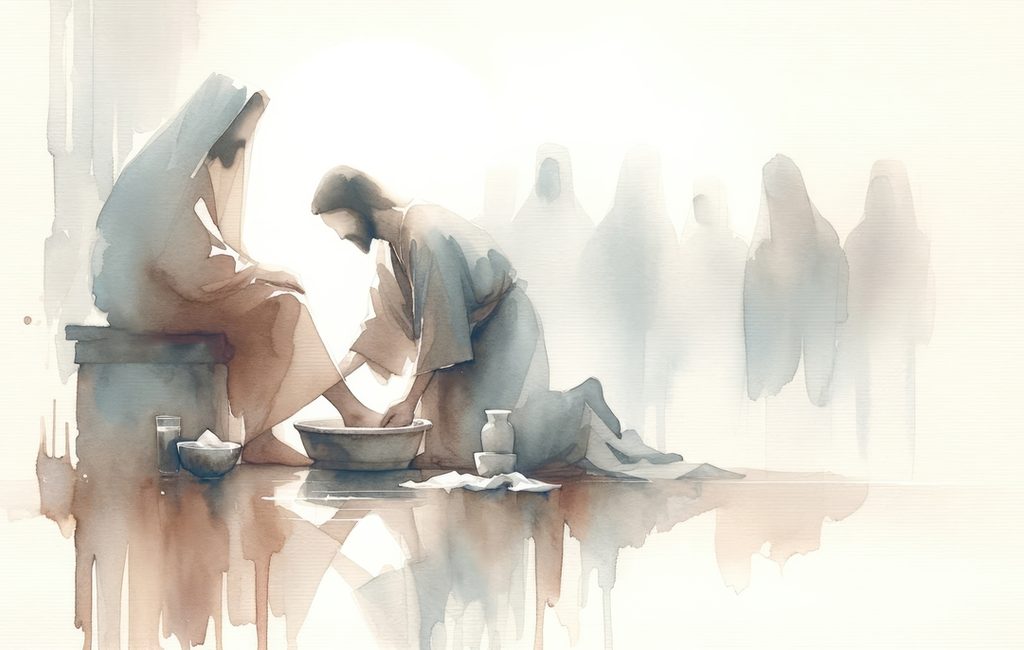
Scripture Engagement: John 13:1–17. Take a moment and read this Scripture engagement three times: once for the eyes, another for the mind, and finally for the soul.
What do you see?
Golden Passage
Now, before the Feast of the Passover, when Jesus knew that His hour had come, that He should depart from this world to the Father, having loved His own who were in the world, He loved them to the end. John 13:1 NKJV.
He Loved Them to the End
His public ministry is drawing to a close. The hour for which He came is upon Him. His ministry has come to a close. Things are moving toward the ultimate reason Jesus came. He knows death awaits Him, and so does resurrection.
In His heart, He’s troubled, but not so troubled that He can’t express love.
Love sent Him here, and love moves Him to this moment—the last hours with the disciples. Imagine yourself as the 13th disciple.
Each of you has spent the last three years learning, listening, and closely following Jesus Christ, the Son of God. You laughed together, slept in the same room or tent. He told stories that warmed your heart. He spoke truth into your soul. A word here, a look there, and that touch on your shoulder—none of it could be replaced.
Yet here He is washing your feet.
Through John’s Gospel, the Holy Spirit invites you into the room where Jesus gathered with His disciples for the Passover Feast, and He wants you to know the truth: Jesus’ love is enduring, loyal, and sacrificial. Listen and learn. Watch and imprint this great love on your heart.
The Master Becomes the Servant
Jesus knew He would leave them soon—very soon—to return to the Father. His love had watched over them until it became their way of life. The loss will be more than heartfelt—they will feel lost.
Yet, here He was washing their feet.
What He’s doing now is calculated and motivated by the need to ensure they’re ready.
As John writes, this scene is from the perspective of memories past. Are there tears in his eyes and tear stains on the scroll? The Holy Spirit prompts John to remember, and something in the scene makes him long even more for Jesus to return now, even as he writes.
As Jesus washes their feet, it is very intimate. He looks into their eyes before He bends low to wash away the dirt of the road they’d traveled that day.
The Master was serving the servant in love eternal.
Many a sermon has reflected on this moment, telling us it’s an example for us to serve. Others have read it over and over again, saying, “That’s good,” before moving on to the rest of the chapter.
Jesus was washing their feet, and that is not all of it. This was prompted more by love than by a mere lesson from the Rabbi.
Love Himself washed their feet—even the feet of the one who would ultimately betray Him.
He Knew What Lay Ahead
You too are a disciple now; you have history with Jesus and expect tomorrow to be the way it has been for the last three years. Jesus knows better.
Read this passage with clear eyes and imagine yourself there: a disciple of disciples, beloved and safe with the Lord.
Watch as He removes His outer garment and takes up the water bowl. He’s moving from one disciple to another, unhurried.
For each of you, it’s a treasured moment that culminates in years of love—years of intimate closeness. Each move He makes is with the knowledge of how much they needed this for strength and endurance.
Much of what we know about the later lives and deaths of the disciples comes from early Church historians and Christian traditions. Some accounts are more reliable than others, but they give us glimpses of the suffering these men may have endured.
Love has its own strength, and each disciple will need to remember Jesus and His love to endure what is coming soon and what will happen before they breathe their last.
As Jesus washes their feet, I wonder whether He is thinking about what lies ahead for each one. He knows the hearts of these men, and He knows what awaits Him now. Each disciple was unique and chosen for a great purpose; is it possible that Jesus is also contemplating how they would make the ultimate sacrifice for so great a love in the future?
Yet, I can’t help but wonder.
As He washes Peter’s feet, does He see him denying Him three times before being restored to fellowship and commissioned to shepherd His sheep? Does He see Peter boldly proclaiming the gospel at Pentecost, writing letters to strengthen the Church, and eventually, according to early Christian tradition, being crucified in Rome?
Then He comes to Judas Iscariot. Does He foresee the kiss of betrayal, the thirty pieces of silver, and the remorse that will eventually drive Judas to return the money before taking his own life?
Imagine that, even with all this knowledge, Jesus kneels to wash Judas’ feet with tenderness.
Now, with the same tenderness, He moves to Andrew; does He know he, too, will be crucified—but in Patras, Greece, on an X-shaped cross? We know this only because Christian tradition has preserved it. Now, He moves to James, the son of Zebedee, who will be executed by the sword on Herod Agrippa I’s orders (Acts 12:1-2).
As He washes Philip’s feet, does He see the miles those feet will travel, carrying the gospel to distant places, before his life ends in Hierapolis? And Bartholomew? Does Jesus see the suffering he will endure, perhaps even being flayed alive and beheaded for his faith?
Then He comes to Thomas. Does He see those feet carrying the gospel far to the east, even to India, where tradition tells us he would eventually die by the spear?
As Jesus washes Matthew’s feet, does He see the former tax collector carrying the good news to distant lands, perhaps even Ethiopia, where some traditions place his martyrdom?
Then He turns to James, son of Alphaeus. Does He see the suffering that lies ahead for this quiet disciple, whom tradition remembers as dying by stoning or being beaten to death? And as Jesus bends low to wash the feet of Thaddaeus, does He see him carrying the gospel into distant lands, eventually suffering martyrdom alongside Simon the Zealot, as Christian tradition tells us?
Now Jesus turns to Simon the Zealot. Does He see the suffering Simon will endure, perhaps even crucifixion or being sawn in two, as Christian tradition tells us?
Finally, Jesus comes to John, the son of Zebedee. Does He see John live to old age, faithfully serve the Church, and leave behind this powerful Gospel, three intimate letters, and, while on the island of Patmos, the Revelation of Jesus Christ? Time tells the tale of God’s faithfulness. I can only imagine John remembering Jesus’ tenderness while he wrote this Gospel.
How beautiful are the feet of those who preach the gospel of peace… Rom 10:15 NKJV
Lord, Are You Washing My Feet?
I imagine each disciple receiving Jesus’ tender attention as He washes his feet. I don’t know about you, but I would have felt unworthy and said, “No, Lord, not me! I should be washing Your feet!”
Then He came to Simon Peter. And Peter said to Him, “Lord, are You washing my feet?” Jesus answered and said to him, “What I am doing you do not understand now, but you will know after this.” Peter said to Him, “You shall never wash my feet!” Jesus answered him, “If I do not wash you, you have no part with Me.” Simon Peter said to Him, “Lord, not my feet only, but also my hands and my head!” Jesus said to him, “he who is bathed needs only to wash his feet, but is completely clean; and you are clean, but no all of you.” For He knew who would betray Him; therefore He said, “You are not all clean.” John 13:6-11 NKJV.
Peter was willing to follow Jesus, but was he willing to receive from Him what only Jesus could give? Certainly, that’s a lesson we all need to learn.
Love One Another as I Have Loved You
Something remarkable has happened in that upper room. Jesus has washed the feet of His disciples, put on His outer garments, and returned to His place at the table. Then He asks them a question: “Do you know what I have done to you?” (John 13:12 NKJV).
Can you imagine the questions in the disciples’ eyes? They have just experienced their Lord and Teacher take the place of a servant and do so with lovingkindness.
But do they understand what He has done? Come, let us listen alongside them as Jesus explains.
You call Me Teacher and Lord, and you say well, for so I am. If I, then, your Lord and Teacher, have washed your feet, you also ought to wash one another’s feet. For I have given you an example that you should do as I have done to you. Most assuredly, I say to you, a servant is not greater than his master; nor is he who is sent greater than he who sent him. If you know these things, blessed are you if you do them. John 13:13-17 NKJV
Imagine the disciples looking at Jesus and then at one another. Have they begun to understand what He has just taught them?
I wonder how many feet they would wash in the years to come as they lovingly and obediently followed their Lord’s example.
How many?
Love is not merely about being loved, but about sharing the love we have received from God. We serve one another not out of obligation or for what we might receive in return, but because His love has taken root in our hearts.
Who Are You Loving Today?
What does loving one another look like beyond that room? Sometimes it means serving someone who cannot repay us. Sometimes it means showing kindness when it isn’t deserved. It may even look like loving your enemy.
Receiving love is just as important as giving it. Before we can share the love of Christ, we must first receive it. His love reaches into the deepest places of our hearts and transforms the way we love others.
As His disciple, you have experienced His love in ways known only in your heart of hearts. You are a walking, living, breathing testimony of His love.
Jesus sent His disciples into the world, and they made disciples who made disciples, generation after generation. Love begets love in so many ways. The good news reveals God’s tender, loving care, and as that message is shared, it spreads throughout the world.
You and I have the privilege of following Him today, and maybe we can find a moment to spread the love we carry in our hearts.
Who are you thinking about loving today?
The next time you have an opportunity to serve someone, remember Jesus kneeling before His disciples with a basin and towel. His love knows no bounds, and His example invites us to love one another.
Jesus not only gave us an example of His love but also assured us that the watching world would recognize His disciples by their love for one another.
A new commandment I give to you, that you love one another; as I have loved you, that you also love one another. By this all will know that you are My disciples, if you have love for one another. John 13:34-35 NKJV.
“We love Him because He first loved us.” — 1 John 4:19 NKJV.





Leave a Reply