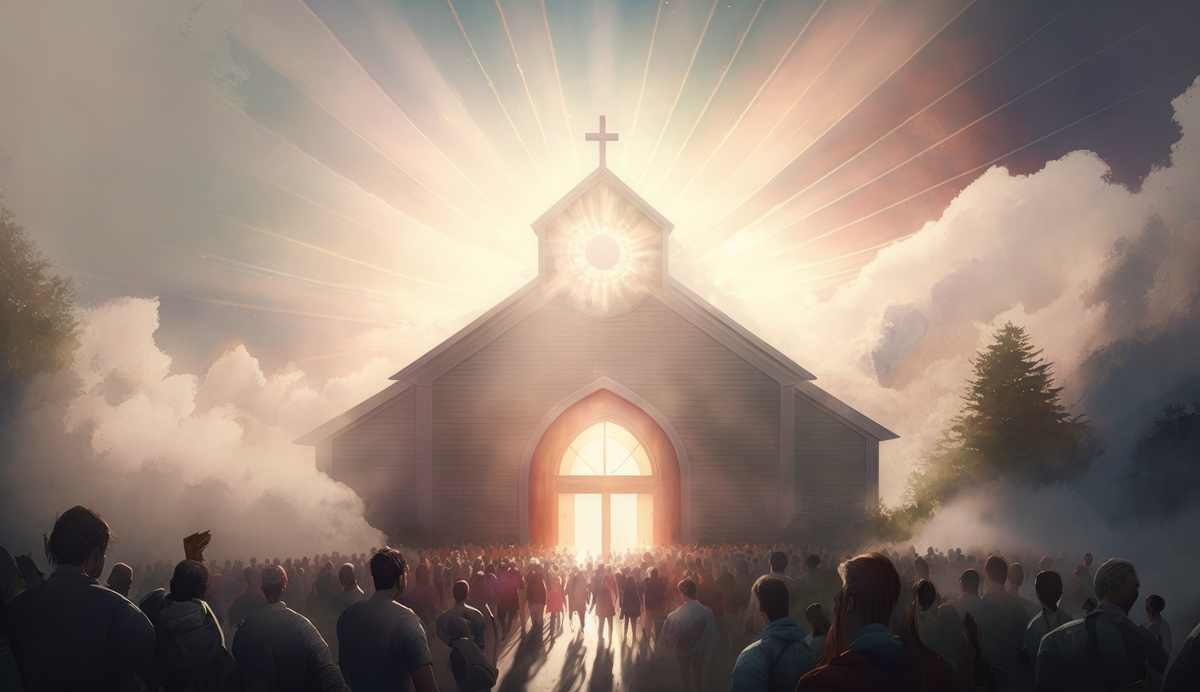
What is the church?
The New Testament defines the church as the community of Christian believers, known as ecclesia (an assembly called out).
It’s not merely a physical building but includes both the universal body of believers worldwide and local congregations. In unity, you will find worship, Bible teaching, gathering in Jesus’ name, and supporting the Great Commission in every church.
- Definition: Often described as the “Body of Christ” or “People of God”.
- Purpose: First, the Great Commission. Then, to worship God, nurture believers (discipleship), perform evangelism, and serve.
- Components: Local churches (individual congregations) and the universal church (all believers in Christ).
- Origin: Derived from the Greek kyriakon (“of the Lord”) and ecclesia (“assembly”).
The Belgic Confession remains a powerful, concise, and often poetic summary of faith, emphasizing devotion under the cross. This confession summarizes the heart of the biblically supported “church”.
We believe and confess one single catholic or universal church – a holy congregation and gathering of true Christian believers, awaiting their entire salvation in Jesus Christ, being washed by His blood, sanctified, and sealed by the Holy Spirit. This church has existed from the beginning of the world and will last until the end, as appears from the fact that Christ is the eternal King who cannot be without a subject. Belgic Confession:
So many churches?
Denominations primarily categorized as churches reflect different theological traditions, governance structures, and worship styles. The vast majority share the fundamental belief that Jesus is God, who died for sins, rose from the dead, and is coming back.
There are differences in leadership structure, sacraments, and worship. But they are united in Christ, awaiting His second coming.
Main Branches of Christianity
- Roman Catholic Church: This church is the largest body of believers, and its leadership structure places the “Pope” as the head. Their number includes the Latin Church and 23 Eastern Catholic Churches.
- Eastern Orthodox Church: Self-governing churches – found in Greece and Russia. They emphasize tradition, mysticism, and the authority of bishops rather than a single Pope.
- Protestantism: Churches stemming from the 16th-century Reformation. They are serious about salvation by faith, the authority of Scripture, and independent, autonomous leadership. There are numerous Protestant denominations and traditions:
- Baptist: Congregational autonomy and emphasis on “believer’s baptism.
- Methodist: Emphasis on a “transforming relationship with God. It grew out of a revival movement supporting personal holiness and social justice.
- Lutheran: Secured in Martin Luther’s theology. They emphasize justification by faith, grace, and worship.
- Anglican/Episcopal: Historically connected to the Church of England. It features a middle-of-the-road approach, combining a “Catholic-like” structure with Protestant theology.
- Presbyterian/Reformed: They’re governed by elders, also known as presbyters. Rooted in the teaching/theology of John Calvin.
- Pentecostal/Charismatic: Holy Spirit-centric. A return to the original church of Acts. Emphasize the experience of God through the Holy Spirit, which includes speaking in other tongues and healing.
- Non-denominational: Churches not officially affiliated with a historic denomination, often sharing Baptist or Charismatic theology.
- Black Churches: Former slaves and freedmen/women (African American worshippers) founded Historically Black Churches. This body of believers includes the African Methodist Episcopal (AME) and the Church of God in Christ.
The truth
Paul wrote to the scattered churches in places such as Corinth, Ephesus, and Philippi. They need instruction, guidance, and correct leadership.
Praise the Lord, Paul would write to the Church of Ephesus, a seemingly irrelevant church, telling them they were the center of a new thing God was doing.
God was gathering all things together in Christ (Eph 1:10), Who was before all things and in whom all things hold together. Jesus came to undo the course of this world, the prince of the power of the air, and the passions of the flesh (Eph 2:1-3).
The new thing?
God’s intent was that now, through the church, the manifold wisdom of God should be made known to the rulers and authorities in the heavenly realms according to the eternal purpose which He accomplished in Christ Jesus our Lord (see Eph 3:10-11).
The watching world is watching. What do they see?
- God gives the gift of His grace through the working of His power.
- Preaching the unsearchable riches of Christ.
- In Him and through faith in Him, we may approach God with freedom and confidence.
In Conclusion: Paul’s Prayer for the Church.
God is sovereign. His will shall be done on earth as it is in heaven. The Church belongs to the Lord – the local and the universal.
Let us receive Paul’s thanksgiving and prayer (Eph 1:15-23) for the Church as our own:
For this reason, ever since I heard about your faith in the Lord Jesus and your love for all the saints, I have not stopped giving thanks for you, remembering you in my prayers.
I keep asking that the God of our Lord Jesus Christ, the glorious Father, may give you the Spirit of wisdom and revelation, so that you may know Him better.
I pray also that the eyes of your heart may be enlightened in order that you may know the hope to which He has called you, the riches of His glorious inheritance in the saints, and His incomparably great power for us who believe. That power is like the working of His mighty strength, which He exerted in Christ when He raised Him from the dead and seated Him at HIs right hand in the heavenly realms, far above all rule and authority, power, and dominion, and every title that can be given, not only in the present age but also in the one to come.
And God placed all things under His feet and appointed Him to be head over everything in the church, which is His body, the fullness of Him who fills everything in every way. Eph 1:15-23 NIV.*
Call to Action
Let him who wants a true church cling to the Word by which everything is held. Martin Luther.
Take the Word of God seriously. Support your church prayerfully, financially, and physically.
The local church and the universal church are still waters that refresh your soul and lead you into a more intimate and real relationship with God.
Follow the Holy Spirit – you can’t go wrong.
“For where the Church is, there is the Spirit of God, and where the Spirit of God is, there is the Church and all grace. Irenaeus.



Leave a Reply